Apps page

The instruments, native on iPhone and iPad.

Selected R-MAP models are built as native apps rather than pages in a browser — because a register you edit with a thumb, a matrix you drag, and a board you glance at on a lock screen are different tools than the same math on a laptop. Free to download. One purchase unlocks the instrument, forever, on your Apple Account.

6On the App Store
3Coming next
0Accounts required
1×Purchase, not a subscription
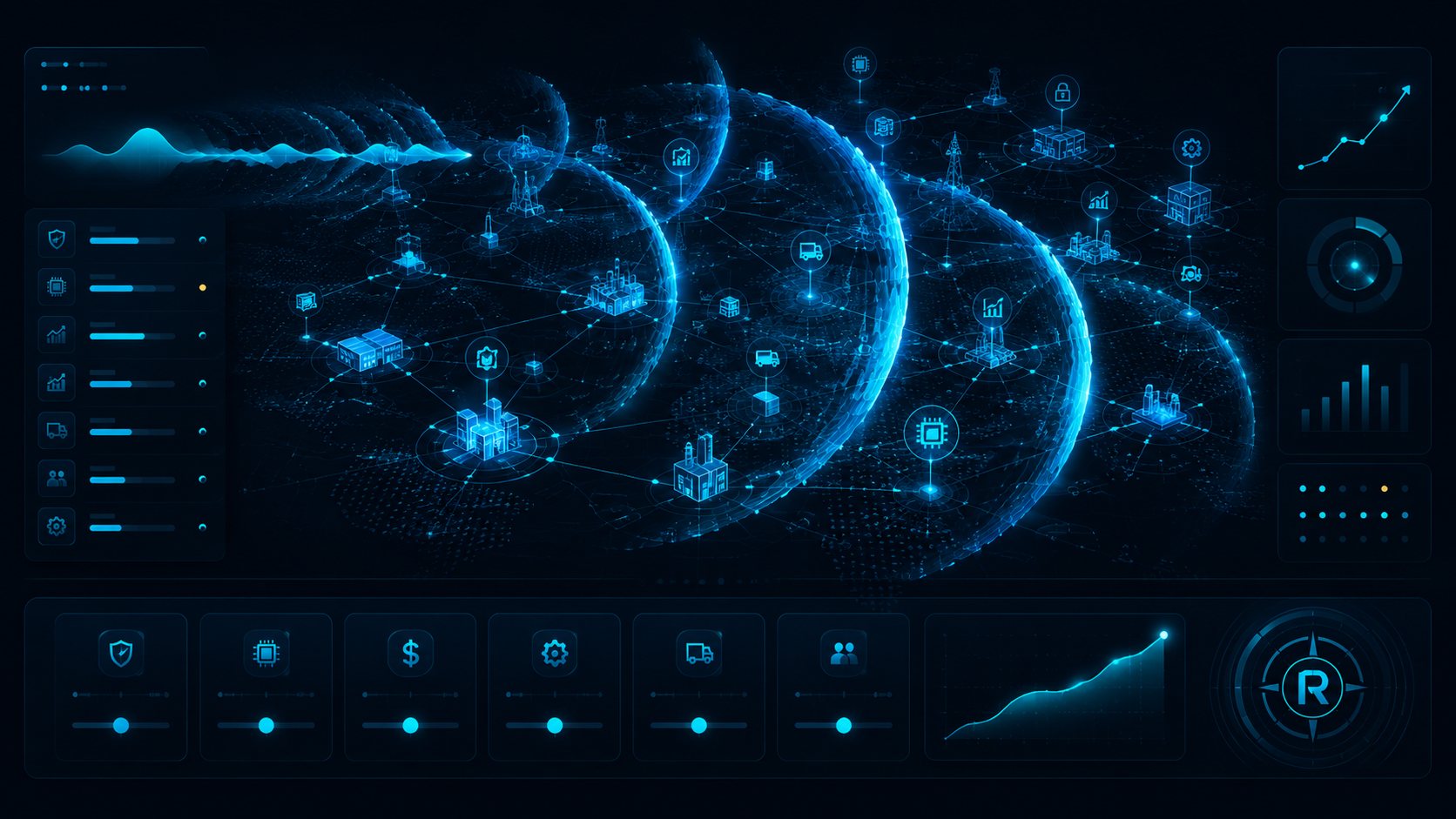
A dense field of connected nodes representing R-MAP's coupled risk instruments
Same rigor, in your hand
Available now

Six instruments, on the store today.

Each is a free download. Caliber and Ideon are free outright; on the paid four, a one-time unlock opens the full instrument — there is no subscription and no recurring charge of any kind. Keystone, Crux, Aegis, Caliber and Ideon run on iOS 18 or later; Meridian needs iOS 26.

R-MAP Keystone app icon

Keystone

See which risks own the tail.

A portfolio risk register with a correlation matrix you can edit and a seeded Monte Carlo behind it. Reports which risks actually drive the tail — usually not the ones that drive the average — and prices the diversification benefit against standalone tails.

Unlock $49.99

View on the App Store →

R-MAP Crux app icon

Crux

Decide, or learn why not yet.

Structured decision analysis: frame the decision, weigh the states, and read the expected value. Then price the question most tools skip — what a further study is actually worth before you commit to it.

Unlock $24.99

View on the App Store →

R-MAP Aegis app icon

Aegis

EHS numbers with honest error.

Industrial-hygiene and EHS calculations done properly: similar exposure groups, mixture hazard index, required respirator protection factor, WBGT heat screening. Screening support with its limits stated — never a compliance determination.

Unlock $49.99

View on the App Store →
R-MAP Meridian app icon

Meridian

The day’s risk, as an estimate.

Seven risk domains treated as one coupled system. Log the outside world, watch a shock travel between domains, run correlation-aware simulation across all seven at once, and read a one-page daily estimate in calibrated language — with method, seed and run count quoted so any reader can reproduce it.

Unlock $79.99

View on the App Store →

R-MAP Caliber app icon

Caliber

Find out how good your judgment actually is.

Log probabilistic forecasts, resolve them when the answer arrives, and watch your Brier score and calibration curve move. The uncomfortable, useful discipline underneath every other instrument here.

Free

View on the App Store →

R-MAP Ideon app icon

Ideon

Run the workshop from the iPad.

Capture ideas in front of a room, cluster forty of them into themes with a finger, then converge: silent NGT voting with a convergence measure, MoSCoW, Six Thinking Hats and a retrospective. Built for the table, not the laptop.

Free

View on the App Store →
Coming to the App Store

Charter, Bracket and Relay, next.

The second wave is built and in store preparation. Each will follow the same rules as the six above — free to download, no account, computed on device, iOS 26 or later. This page is updated the day each one goes live.

Charter

AI governance you can hand to an auditor.

A register of the AI systems you run, each walked to its EU AI Act tier with the answers recorded. Obligations on a dated runway, an incident log with the reporting clock and exact rate intervals, ISO/IEC 42001 controls with evidence attached, and a signed dossier at the end.

Coming to the App Store

Bracket

How wrong is this forecast likely to be?

An interval calibrated on your own recent misses, with a distribution-free coverage guarantee, candid about when it cannot yet certify the level you asked for — and a change-point watch for the shift that would void it.

Coming to the App Store

Relay

An evidence ledger that keeps the receipts.

State a claim and the prior you hold, log each piece of evidence as a word and see its consequence before you commit, then settle the claim and find out whether following the evidence beat your first instinct.

Coming to the App Store
How the apps work

On your device, and only your device.

The same commitments apply to every app on this page.

No account, no feed, no backend

There is no sign-in and nothing to create. The apps compute everything locally and work fully offline; a connection is involved only when the App Store itself processes a purchase or a restore. What you type stays on the phone — the privacy page covers this in one short section.

One purchase, not a subscription

Each paid app is free to download with a single non-consumable unlock. It is tied to your Apple Account rather than a device: on a new phone or after a reinstall, open the app’s settings and tap Restore purchase. Apple re-validates it and the instrument unlocks at no further charge.

Free tiers that stay free

Every paid app is usable before you pay, and not as a countdown. Keystone ships a full example portfolio, Crux a worked decision, Aegis its calculators, Meridian its whole input-and-monitoring loop. What the unlock buys is scale and the analytical instrument — never the ability to open the app again.

The model tells you when it is straining

Where an engine has to distort what you gave it — a correlation matrix repaired, a coupling clipped at its cap, a distribution that cannot honor all three numbers you typed — the app says so on screen, next to the number. That disclosure is the product, not a footnote to it.

Alongside the platform

The apps do not replace the library.

The browser platform remains the full catalog — every model, every Knowledge Web, the deep analytical work that wants a large screen and a keyboard. The apps take the handful of instruments that genuinely belong in a pocket or on a table and rebuild them natively for that. Membership and app purchases are separate: buying an unlock does not require an R-MAP account, and a membership does not carry into the App Store.